
single post
Subscribe to receive all updates on O’Shane Bryant Fitness Limited.




Side Note: In this article we have included secondary sources with hyperlinks for reference.
Keke Palmer has built a career around being active. She is an actress, singer, producer, entrepreneur, mother and television personality. In recent years, she has also become increasingly open about how she manages her health and wellbeing.
Her approach has changed over time. Earlier in her career, Keke focused more on intense workouts and appearance. Today, she talks more about strength, mobility, mental clarity and feeling good.
Keke has also spoken publicly about living with PCOS (now known as PMOS), severe acne and digestive sensitivities, as well as the emotional impact of not initially understanding what was happening with her body.
To fight her way through this challenge, Keke’s wellness routine includes exercise, therapy, journaling, prayer, meditation, yoga, pilates, rest and setting boundaries around work.
One of the clearest themes in Keke’s approach is that wellness does not have to be extreme.
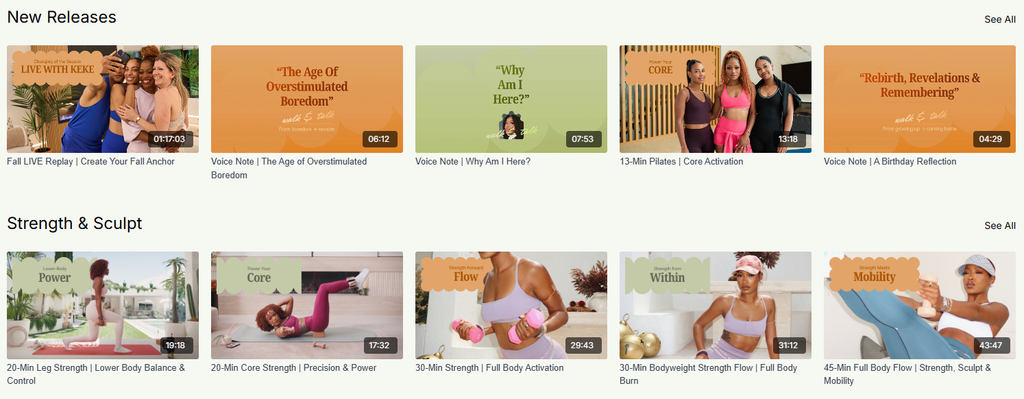
Her wellness platform, Practice by Palmer, focuses on low-impact workouts, reflection and routines that can fit into everyday life, even when someone has limited time.
Rather than promoting long workouts or restrictive diets, her approach emphasizes finding activities you enjoy, understanding your body and building habits you can maintain.
That idea applies beyond celebrity wellness. A routine that looks impressive but cannot be maintained is unlikely to be useful in the long term.
Pilates has become a major part of Keke’s fitness routine. She has said she became more interested in it after becoming a mother and looking for an alternative to the intense cardio and strength workouts she had previously preferred.
She describes Pilates as both athletic and mentally calming. Concentrating on the movements gives her a chance to focus on her body and quiet outside distractions.
Keke eventually became a certified instructor and launched Practice by Palmer, where she teaches Pilates alongside other forms of movement.
Research suggests Pilates may improve muscular endurance, balance, flexibility and physical function, although evidence varies depending on the outcome. It is not necessarily superior to other forms of exercise, but enjoyment can make it easier to exercise consistently.
The takeaway: You do not necessarily need the hardest workout. You need movement you can do regularly.
Pilates isn’t Keke’s only form of exercise. She has also talked about yoga, hiking and other activities that she enjoys.
Her attitude toward yoga has changed over time. She initially approached it partly because she wanted to prepare her body for action movies. Eventually, she began viewing exercise less as a way to achieve a certain appearance and more as a way to connect her mind and body.
Keke has also described enjoying hiking alone, which gives her time away from the constant social demands of her career.
Walking and hiking are accessible forms of physical activity that can provide cardiovascular benefits without requiring specialized equipment or a gym membership.
Keke’s wellness routine also focuses heavily on mental health.
She has discussed using:
Keke has said journaling helps her process her thoughts and feelings. She also deliberately makes time to relax and has discussed using sleep and naps when she feels overloaded.
When preparing for major projects, she has sometimes reduced other commitments so she can focus on one thing at a time.
Journaling may also have some mental-health benefits. Research suggests expressive writing can produce modest improvements in symptoms of depression, anxiety and stress, although the evidence varies.
It should not replace professional mental-health care, but it can be one useful tool within a broader approach to managing stress.
Keke has also discussed meditation and describes Pilates itself as a meditative experience.
Her point is less about spending hours meditating and more about creating periods where she can focus without constant distractions.
For someone trying to apply this idea, even a short period without notifications, multitasking or outside demands can provide an opportunity to slow down and reset.
Food has become another important part of Keke’s wellness journey, particularly because of her experiences with PMOS and digestive sensitivity.
She has said she pays attention to which foods work well for her body and does not necessarily follow restrictive ideas about what foods are considered “good” or “bad.”
For example, she has discussed eating foods such as rice and potatoes alongside protein, beans and fiber.
Her approach is individualized rather than a universal diet plan.
This is consistent with current PMOS guidance, which does not identify one specific diet as being best for everyone with the condition. Instead, guidelines emphasize sustainable healthy eating based on individual preferences, needs and goals.
The lesson isn’t to copy Keke’s diet. It is to focus on overall nutritional quality and sustainability rather than automatically following restrictive food trends.
One of the most significant parts of Keke’s health story is her experience with PMOS.
In 2020, she publicly discussed her diagnosis after years of severe acne and frustration with treatments that had not addressed the underlying issue.
She later spoke about the emotional impact of dealing with severe acne and feeling as though she was doing everything right without understanding the cause.
Her experience also highlights an important distinction in wellness culture: healthy lifestyle habits and medical treatment do not have to be opposites.
Keke has embraced holistic practices while also acknowledging the role of doctors and medication in managing her condition.
Current PMOS guidelines similarly recommend lifestyle management, including healthy eating and physical activity, alongside individualized medical care.
For anyone experiencing persistent symptoms, the lesson is not to rely on generic wellness advice. Understanding the underlying cause and speaking with a healthcare professional can be important.
Sleep is another part of Keke’s approach to wellness.
When her schedule allows, she has described a nighttime routine that can include an early dinner, a bath, skincare, journaling and watching familiar shows before bed. She has also discussed using naps and sleep as a way to recover when she is overwhelmed.
The specific products and rituals are less important than the principle: recovery matters.
Adults generally need at least seven hours of sleep per night on a regular basis for optimal health.
A simpler version of Keke’s approach could involve:
Keke’s routine is not a prescription for everyone, but several principles are broadly useful.
1. Find exercise you enjoy
Keke’s shift toward Pilates shows how enjoyment can make exercise more sustainable.
2. Don’t make appearance the only goal
Exercise can support strength, mobility, mental health and overall wellbeing—not just changes in body shape.
3. Pay attention to your body
Keke’s approach to food and exercise involves noticing how her body responds. That does not mean following every wellness trend; it means developing awareness of your individual needs.
4. Make room for mental health
Journaling, prayer, meditation, therapy, movement and time away from work can all be part of a broader stress-management strategy.
5. Make recovery a priority
Sleep and rest are part of a healthy lifestyle, not obstacles to it.
Keke Palmer’s approach to wellness is ultimately less about perfection and more about consistency.
Pilates and other forms of movement help her stay active. Journaling, prayer and meditation provide space for reflection. Sleep and downtime support recovery. Her approach to food focuses on what works for her body, while her experience with PCOS has reinforced the importance of professional medical care.
You don’t need to copy a celebrity’s entire routine to benefit from its underlying principles.
Move regularly. Eat sustainably. Get enough sleep. Make time to decompress. Pay attention to your body. Protect your mental health. And seek professional help when something doesn’t seem right.
This is a more realistic approach to wellness than trying to be perfect.