
single post
Subscribe to receive all updates on O’Shane Bryant Fitness Limited.




“Earthquake insurance, a specialized form of property coverage, provides essential protection for clients living in seismically active regions. Standard homeowners’ policies typically exclude damage resulting from earthquakes, making earthquake insurance a must.” Insurance Business, 2025; Retrieved November 3, 2026.
It is generally known by the home insurance market through commercials and other marketing forms, of the major earthquake insurance providers. As a stout soccer/football fan of Arsenal FC, it’s been common for me to see at half-time, commercials by home insurance providers such as State Farm, Liberty Mutual, Geico & Progressive on USA Network. What isn’t generally known however by the buyers and sellers of earthquake insurance alike, is/are:
As a buyer of earthquake insurance for your home, you must know that earthquake shaking intensity is equally, and in some sense, more significant as a precursor of home damage during & after an earthquake, compared to just magnitude alone. So, while big earthquakes in magnitude (generally Mg 7 and above), tend to get most media attention; and whereas seismic hazard maps tend to be used by earthquake insurance providers to help them calculate insurance risk as well as home insurance premiums, there is generally still a gap in earthquake intensity data specifically at the intra-state scale, subsequently linking to its application, interpretation & acceptance by the home insurance market.
Take note of the 2023 USA National Seismic Hazard Map/Model created by the USGS, below. As you can see, this map depicts the states and regions within states where damaging earthquakes in intensity (Modified Mercali Intensity VI) is likely to occur in 100 years. Standout states are:
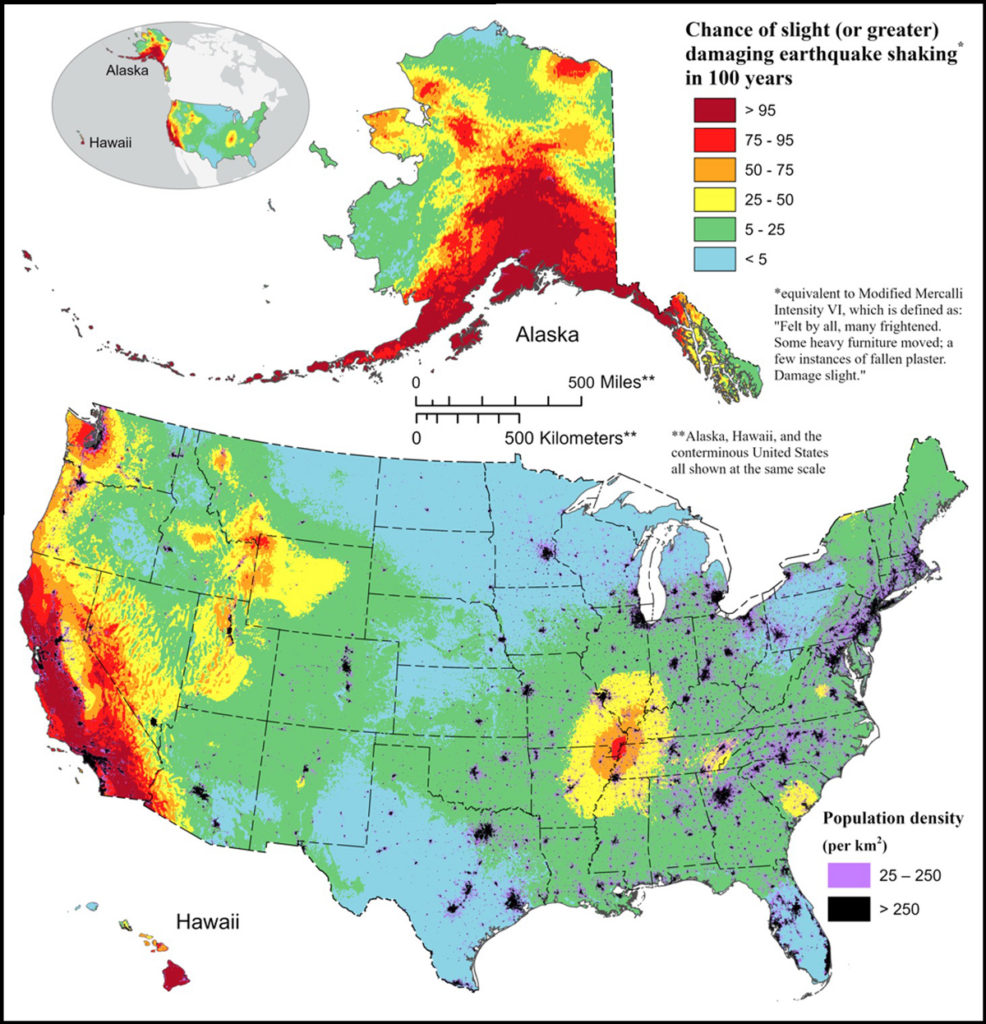
2023 Seismic hazard map of the USA, Retrieved from EOS.org on November 3, 2026.
Now, generally, what you should be able to gather is that California, Hawaii & Alaska have the widest spatial area of experiencing damaging earthquake shaking in an earthquake with an intensity of VI. So this makes for a relatively easy case for you as a home buyer or owner within these states, to be paying the highest premium rates.
For states such as Illinois, Kentucky, Tennessee, Arkansas & Missouri, this is an example of the intra-state gap in intensity data and representation of same, at this map scale. This highlight circle the point we made in section 1 herein, re the current state of earthquake science in the USA, which is:
As more earthquake science data such as active fault maps models, become available for the home insurance & the real estate markets–state by state or city-by-city–buyers of earthquake insurance and residential real estate alike, should anticipate future increases in related prices. And this is applicable for regions (state & intra-state) that may show as yellow or green zones on the 2023 USA seismic hazard map herein.
If a big earthquake (Mg 7+) occurs far away from cities, and/or dense population locales, then it’s highly unlikely that that earthquake will be considered as a disaster. If that same earthquake was to occur (scenario-speaking), on the San Andreas Fault zone in California however, millions of Californians and their homes within say a 10-50km radius will be within range of severe shaking. This is an example of how the population density variable in respect of earthquake intensity & return periods, is another major determining factor of earthquake insurance pricing. And whereas earthquake intensity & hazard maps are intrinsic to the local & regional geology, as well as related conditions/factors; population density can be controlled jointly by human & physical geography factors.
These can include:
Read Related: Florida Home Insurance
It’s because of this wide net of population density determinants, why my second point raised in the first section herein, holds.
What is a constant, is that population density changes over time. Therefore, on this basis alone, if we are to have a population density of 250 per km square (black spots on the 2023 seismic hazard map herein), spreading to the orange and red earthquake shaking zones of Kentucky, Tennessee, Arkansas & Missouri, for example, then this population density increase/shift, is likely to result in an increase in earthquake insurance premiums for coverage, for those same regions.
Source: Visual Capitalist. Retrieved November 3, 2026.
Omitting California & Hawaii with their minor decline in population size, all other earthquake vulnerable states highlighted, experienced an increase in population. This therefore is a likely causative factor behind the general 2025 projected double digit (percentage) increase in home insurance rates in California, Hawaii, Arkansas & Illinois, as shared on realtor.com
Omitting Tennessee, Alaska & Hawaii which experienced -2.3% -1.7% and 0.0% change respectively, Arkansas (0.4%), Missouri (0.5%), Illinois (1.0%), Kentucky (1.7%), Washington (3.5%) & California (5.0%) all experienced increase in home insurance premiums within the 1st part of 2026 alone.
Source: Insurify.com Retrieved November 3, 2026.
based on this trajectory, it is highly likely that home insurance premiums, as well as specialized earthquake coverage, is likely to push forward an increased payment burden on home and related property owners, within these states of the USA, for the same/similar period of 2027.